
ConversionFlow ran 20,000 customer surveys for Figgy Play. One open-ended question revealed something the brand had never noticed: customers didn't call the product's accessories "add-ons." They called them "expansion packs." The copy change took five minutes. The result was a 33.67% jump in conversion rate and a 42% increase in revenue per visitor.
That result didn't come from a bar chart. It came from a sentence a customer wrote in their own words.
Most guides to market research survey questions are written for product managers who want charts and averages. This one is for copywriters who want sentences. The questions that work for a business decision and the questions that work for a headline are not the same. The difference is in how you ask.
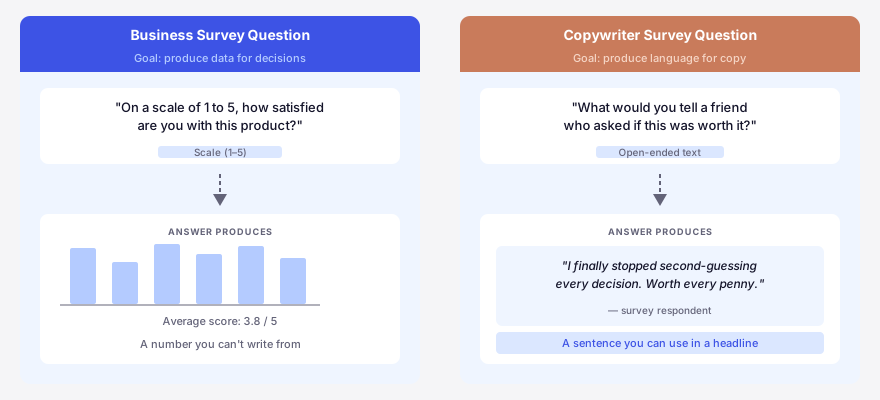
The survey question that consistently produces headline-ready language: 'What would you tell a friend who asked if this was worth it?' It forces plain, honest language — the word-of-mouth pitch the customer already has in their head.
Why Copywriter Survey Questions Are Different
A business survey produces measurable data. A five-point scale gives you an average you can track over time. A multiple-choice question gives you percentages you can put in a slide deck. Both are useful. Neither gives you words you can write with.
A copywriter's survey has one job: get the respondent to write something you couldn't have written yourself. That means almost every question needs to be open-ended. And it means the phrasing of each question controls what kind of answer you get.
Ask "How satisfied are you?" and you'll get a number. Ask "What would you tell a friend who asked if this was worth it?" and you'll get a sentence that might end up in a headline.
This is why most standard survey advice doesn't help copywriters. You're not collecting inputs for a dashboard. You're collecting raw material for copy. That changes every question you ask.
If you want to understand where surveys fall short for copy research in general, read why surveys fail for copywriting research. This article focuses on what to ask when you do run a survey.
Questions That Reveal How Customers Describe the Problem
These questions surface the language customers use before they know about your product. That's the language that belongs in your headlines, subject lines, and ads. It's the language of the problem, not the solution.
"How would you describe this problem to a friend who has never heard of it?" This forces plain language. The answer skips the jargon and gets to the raw feeling.
"What were you searching for right before you found this product?" This gives you Google-query-level language. The exact words someone types when they're actively looking for a solution.
"What did you try before this, and why didn't it work?" This produces objection language disguised as a backstory. The answer tells you what alternatives exist in the customer's mind and why each one failed.
"How long had this been a problem before you did something about it?" This tells you when pain crosses the threshold from bearable to urgent. That moment belongs in your copy.
"What made you finally decide to do something about it?" Trigger events. The answer is often a very specific moment or feeling. It belongs in your ad hooks and email subject lines.
"If you were explaining this problem to your boss, how would you phrase it?" This reveals the professional framing. It's the version the audience uses when they need to justify a purchase to someone else.
You don't need all six in every survey. Pick the two or three that match what you're writing. For a deeper look at how client briefing questions and customer questions serve different purposes, read the two research tracks every copywriter needs.
Questions That Surface Objections and Hesitation
These questions get at the friction. The answers belong in your guarantee copy, FAQ sections, objection-handling sequences, and any moment in the copy where a prospect is about to walk away.
"What almost stopped you from buying?" The most direct objection question you can ask. Customers who bought will answer honestly because the barrier is already in the past.
"What would you say to someone who was on the fence about this?" This inverts the objection. Instead of describing their own hesitation, they argue past it. The answer is often your best objection-handling language because it comes from someone who already crossed the line.
"What did you worry might go wrong?" Fears, not objections. The answer tells you which promise to make, and often which guarantee will land.
"Was there a moment when you almost backed out? What happened?" This produces a specific story. Specific stories are more credible in copy than generalized statements.
"What question do you wish you could have asked before buying?" This tells you what information was missing during the decision. The answer often points directly at a missing FAQ entry or a section your sales page doesn't have.
For how to turn this language into copy once you have it, read how to use customer language in copy.
Questions That Produce Testimonial-Quality Language
These questions extract outcome language: the before/after sentences that belong in your headlines, bullets, testimonials, and social proof sections.
"What's the single biggest change you've noticed since using this?" The word "single" forces prioritization. The answer is usually your strongest benefit statement.
"How would you describe this to someone who has never heard of it?" Customers use the most accessible, honest language available. Often better than anything on the existing sales page.
"What would you miss most if this went away tomorrow?" This reveals what people actually value, which is rarely what the product page leads with. It answers the question: what is the real job this product does?
"What were you hoping would happen, and what actually happened?" This is your before/after frame. The answer is a testimonial structure handed to you ready to use.
"Can you describe the moment when you realized it was working?" Specific. Visual. The answer often produces vivid, credible copy that satisfaction ratings never could.
How to Match Survey Questions to Awareness Stage
The questions above don't all fit every customer at every point. Where someone sits in their awareness of the problem changes what they can answer honestly.
Problem-aware customers know they have a problem but haven't found a solution yet. Ask them:
- "What words would you use to describe this frustration to someone who gets it?"
- "When does this problem feel worst?"
Solution-aware customers know solutions exist but haven't picked one. Ask them:
- "What's stopping you from picking a solution right now?"
- "What would the right solution need to do that the ones you've seen don't?"
Product-aware customers know your product exists and are evaluating it. Ask them:
- "What made you look at this specifically over other options?"
- "What would push you to make a decision today?"
Matching questions to stage keeps your survey focused. A problem-aware customer can't answer product comparison questions yet. A product-aware customer doesn't need to explain what the problem is. They've already explained it to themselves a hundred times.
For real examples of how voice of customer language performs at each awareness stage, read real voice of customer examples for copywriters.
Find the words your customers already use
PhraseMine analyzes real Reddit conversations for your research topic and organizes them by theme. Get the raw, unfiltered language your audience uses, with no survey recruiting required.
Try PhraseMine freeWhen Survey Questions Are Not Enough
Surveys have a built-in problem: people know they're being watched. Even in anonymous surveys, respondents tend to polish their answers. They give you the version of their opinion they'd be comfortable defending out loud, not the version they feel privately.
Reddit and review sites don't have that filter. When someone writes a product review at 11pm, they write for themselves. The language is raw, specific, and almost always more copy-ready than a survey answer.
This doesn't mean surveys are useless. Surveys let you ask something specific. Reddit gives you whatever the conversation happened to produce. Both have a place.
Use surveys when you need to ask something specific that conversations don't happen to cover. Use Reddit and reviews when you want unguarded language at scale. PhraseMine pulls Reddit conversations around your research topic and organizes them by theme, so you can browse what customers actually say without spending hours in the search bar.
The two methods together are stronger than either one alone. For a step-by-step approach to Reddit research, read how to mine Reddit for copywriting research.
A 10-Question Market Research Survey Template
This template works for a post-purchase survey, a customer research outreach, or a client's existing customer base. All questions are open-ended. Keep the survey to 10 questions maximum. Completion rates drop sharply beyond that.
| # | Question | Copy output |
|---|---|---|
| 1 | How would you describe the problem this solved, in your own words? | Headline language, opening hook |
| 2 | What were you searching for when you found this? | Google-query-level language for ads and SEO |
| 3 | What had you tried before this, and why didn't it work? | Objection handlers, competitive positioning |
| 4 | What almost stopped you from buying? | FAQ copy, guarantee language |
| 5 | What did you worry might go wrong? | Risk-reversal copy, proof positioning |
| 6 | What would you tell a friend who asked if this was worth it? | Value proposition, testimonial seed |
| 7 | What's the single biggest change you've noticed? | Benefit bullets, outcome headline |
| 8 | What would you miss most if this went away? | What the product actually does for them |
| 9 | What question do you wish you'd been able to ask before buying? | Missing FAQ entries, objection gaps |
| 10 | Is there anything about this that surprised you, good or bad? | Unexpected wins to feature, hidden friction to fix |
A plain Google Form works for this. You don't need a dedicated survey platform to start.
If you don't have customers to survey yet, PhraseMine lets you pull real conversation data from Reddit so you can start mining copy language before your first sale.
Your Starting Point
Pick three questions from the lists above and add them to your client onboarding intake form. Run them on your next project.
The goal isn't a thousand responses. It's one sentence that sounds more true than anything you could have written on your own. That sentence already exists. Someone has already said it. Market research survey questions are how you find it.