
Most "customer research questions" lists are client questionnaires in disguise.
They ask about the product, the target audience demographics, the competitors, and the brand voice. That's useful. But those are questions you ask your client. They're not the same as questions you ask real customers.
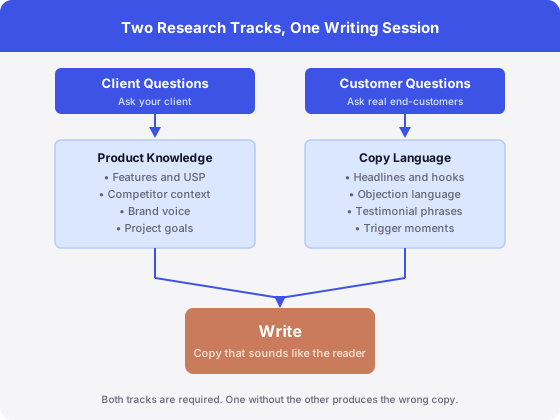
Client questions tell you what the product does. Customer questions tell you how people talk about the problem. You need both sets of customer research questions before you write anything. And they produce completely different outputs.
Here's how to run both.
Two Research Jobs You Should Never Confuse
When you research a copywriting project, you're doing two separate jobs.
Job one: understand the product. You need to know what it does, who it's for, why it's different from alternatives, and what the client wants visitors to do. These answers come from your client.
Job two: understand the buyer. You need to know how real people describe the problem in their own words, what made them go looking for a solution, and what held them back from buying. These answers don't come from the client. They come from actual customers.
Writing from only Job one produces product-centric copy. It sounds like the brand wrote it. Writing from both produces copy that sounds like the reader wrote it.
Testive shows what goes wrong when you skip Job two. The test prep company had built a site targeting high school students. Customer research revealed the real buyers were mothers making decisions for their kids. The entire site was aimed at the wrong person. Fixing that required going to actual customers, not the client.
Questions to Ask Your Client Before You Write Anything
These six questions establish the product. They give you what the offer does, who it's for, and how it fits the market.
1. What's the single most important action you want visitors to take? This clarifies the primary CTA and what conversion means for this project. Without a clear answer, you'll write for the wrong outcome.
2. Who is actually buying right now (not who you wish was buying)? Ask for real buyers, not the ideal customer profile. If the client hesitates, pay attention. There's often a gap between who they think their customer is and who's actually paying them.
3. Why do customers say they chose you over alternatives? This is your value proposition in customer language. If the client can quote actual feedback, use it. If they can't, that gap tells you what customer research will need to fill.
4. What do customers say after they buy? Do you have testimonials or feedback to share? Testimonials are a research source, not just social proof. Read them for recurring phrases. Whatever shows up repeatedly is what the market cares about most.
5. What objections come up most often before someone buys? Every objection the client names needs an answer somewhere in the copy. This produces FAQ content, pricing page copy, and objection handlers.
6. Who are your main competitors and what makes you different from each? This surfaces differentiator bullets and tells you what language to avoid (claims you can't outrank) versus what to own.
These answers establish the product. Now you need the buyer.
Customer Research Questions That Actually Produce Copy
These are the questions to ask real end-customers. When interviews aren't possible, you answer them using public sources. Each question produces a specific type of usable copy.
1. "Describe this product in your own words." This surfaces the vocabulary your audience already uses. It's almost always different from how the client talks about the product. Use it verbatim in the opening paragraph. Rachael Pilcher at Wynter is direct about it: "You'll end up with a fantastic pile of information you can pull words and phrases out of."
2. "What was going on in your life that made you start looking for something like this?" This is the trigger moment. It's headline gold. When you know what pushed someone to start searching, you can open a page at exactly that moment. The copy joins a conversation already happening in the reader's head.
3. "What did you try before this, and why didn't it work?" This tells you how market-aware your buyer is, what alternatives they've tested, and the language they use to describe disappointment. If five people name the same competing solution and the same failure, that's a section of your sales page.
4. "What made you hesitate before buying?" Every hesitation is an unaddressed risk. The answers here produce your objection handlers, your guarantee language, and your FAQ page. They tell you which concerns to address early and which can wait until later in the copy.
5. "If a friend asked you why they should use this, what would you tell them?" This produces the word-of-mouth pitch: the simplest, most honest version of the value proposition in customer language. It's often more accurate than anything the client gives you.
What to Do When You Can't Interview Customers
Most copywriters start a project without access to real customers. The client is new, the product has no existing buyers, or there's no budget for research calls.
That's the normal situation. The answers still exist. They live somewhere public.
Reddit threads. Real people describe the problem, vent about alternatives, and ask questions your future buyers are asking. Organized by subreddit, searchable by keyword. A thread in the right community is a live customer interview with 50 respondents.
Amazon, G2, and Trustpilot reviews. Three-star reviews are the most useful. They're honest. Not glowing enough to be brand-approved, not angry enough to be noise. They describe exactly what someone hoped for and where reality fell short. That gap is your copy.
Sales call transcripts and support tickets. If the client has them, every question a prospect asked before buying is an objection waiting to be addressed in the copy.
PhraseMine was built for exactly this gap. Paste in a brief describing the product and market, and it surfaces real Reddit conversations organized by theme. You get customer language without scheduling a single interview.
For the full Reddit research method, how to mine Reddit for copywriting research covers the process step by step.
Get the customer side of the research without scheduling interviews
PhraseMine surfaces real Reddit conversations about your market, organized by theme. You hear the actual language before you write a word.
Try PhraseMine freeThe Three Questions That Produce the Most Copy Gold
Not all questions deliver equally. These three consistently produce language you can use verbatim.
The single most powerful customer research question: 'What was going on in your life that made you start looking for something like this?' It surfaces the trigger moment — the exact sentence that belongs at the top of an ad, an email, or a landing page.
"What made you start looking for this?" This surfaces the trigger moment. Use it as your headline or opening hook. It's the sentence that stops someone mid-scroll because it describes exactly where they are right now.
"What were your hesitations before buying?" This surfaces doubt language. Use it for your objection handlers and guarantee copy. Address the hesitations and you remove the friction that kills conversion.
"How has your life or business changed since using it?" This surfaces transformation language. Use it for your benefit bullets and testimonial section. It describes what the buyer is actually paying for: not the product, but the after.
The Family Birth Center case shows why this matters in practice. Copywriter Megan Kachigan (2026) discovered the client was answering the same ten customer questions by phone and email repeatedly because the website didn't address them. Customer research surfaced which questions kept coming up. Baking the answers into the copy eliminated that repetitive work and converted visitors who had been leaving because the site left them unsure.
Finding those recurring questions requires listening to real conversations. PhraseMine does that automatically. Paste a brief and it surfaces what real people are asking about your market, organized by theme.
For more on what this looks like when it works, real voice of customer examples for copywriters shows the before-and-after copy changes with measurable outcomes.
How to Use What You Find
The research only works if you use the exact words. Not a cleaner version of them.
Rachael Pilcher at Wynter puts it directly: "Don't try to paraphrase things. All the power is in the exact words your customers use." If three customers call the problem "drowning in revision rounds," put that phrase in the headline. Don't translate it into something that sounds more polished.
Three rules for turning research into copy:
- Spot repetition first. If the same phrase shows up across five different customers, it belongs in your headline. Frequency is signal.
- Map answers to where they belong on the page. Trigger-moment language goes in the opening. Hesitation language goes mid-page. Transformation language goes in the close.
- Read testimonials twice. After writing from research, scan every testimonial for phrases you missed. Anything in quotes can be lifted verbatim.
For the framework behind this method, voice of customer research for copywriters covers it in full. For what research-driven copy looks like in practice, writing sales copy that sounds like your customer shows the before-and-after.
The list isn't the work. Knowing what each question produces, and where to find the answers when you can't interview anyone, is what makes a research session useful instead of just thorough.
Two sets of questions. One for the product. One for the customer. Run both before you write anything.