
You know the concept. Collect the exact words your customers use. Mirror them in your copy. Convert better.
But knowing the concept and seeing it work in practice are different things. This article covers the second part: four real voice of customer examples with specific, documented outcomes. Plus a four-question framework for recognizing a phrase worth using, and a five-column template you can fill in before your next project starts.
If you are new to VoC research and need the foundation first, read Voice of Customer Research for Copywriters and the complete guide to finding customer language on Reddit. This article picks up where those leave off.
Four Voice of Customer Examples That Changed Real Copy
These are not hypotheticals. Each one shows what changed, why it changed, and what the outcome was.
The 22-word change at LivePlan
Copywriter Dustin Walker ran an A/B test on LivePlan's homepage. The site had solid traffic. It was not converting the way it should.
Walker rewrote the hero copy using customer language. He addressed both a short-term and a long-term benefit that customers had described in their own words when talking about business planning. The total change was 22 words. Sales went up 16%.
The takeaway is not that small edits always work. It is that when the words match what customers already believe, the edit does not need to be big. The customers had already said the truest thing. The copy just had not caught up yet.
Testive's wrong audience assumption
Testive made SAT prep software. They assumed their main customer was the high-school student who would take the test. Customer research revealed the mothers were making the purchase decisions.
They rewrote the website to speak to the parent making the call, not the student taking the exam. The copy did not change the product. It changed who the page was talking to.
This is one of the most common things VoC research catches: the company thinks they know who the buyer is. The research shows someone different. No amount of polished writing fixes copy aimed at the wrong person.
"Find suppliers you can rely on"
A copywriter was writing for an international B2B marketplace. Their first draft was generic. It did not land. They went back and researched customer conversations, including Reddit threads where buyers discussed their experiences with marketplace platforms.
One theme came up repeatedly. Buyers were not primarily worried about price or features. They had been burned by unreliable suppliers before and did not want it to happen again. That fear was the actual purchase driver.
The copywriter led the headline with exactly that: "Find suppliers you can rely on." Conversions jumped. The insight did not come from a creative brief. It came from reading what customers wrote to each other in public forums.
Fintech homepage: 18% more conversions, no product changes
During win/loss interviews for a fintech client, researchers asked customers to describe the product in their own words. The language they used was completely different from the company's internal marketing copy.
They rewrote the homepage using customer phrasing instead of internal marketing language. Conversion rate went up 18%. The product did not change. The words did.
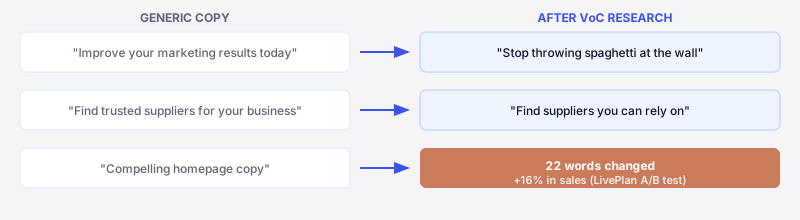
Four examples, four versions of the same insight: the customer had already said the truest thing about their situation. The copywriter's job was to find it and put it in the right place on the page.
Before
“Find Trusted Suppliers for Your Business”
After
Find Suppliers You Can Rely On
Before
“Improve Your Marketing Results Today”
After
Stop Throwing Spaghetti at the Wall — Write Copy That Actually Converts
A Four-Question Framework for Recognizing a Phrase Worth Using
You can find hundreds of customer phrases in a single research session. Most of them are noise. Here is a practical voice of customer framework: four questions that separate a phrase worth using from one that just sounds interesting.
Does it sound like the reader talking to themselves?
The most useful phrases are ones the reader could have said. Not things they said to a researcher but things they said in their head, or to a friend. "I spend half my day chasing people for status updates" is what a project manager actually thinks. "The user experience could be improved" is what they say in a survey. The first belongs in copy. The second does not.
Is it specific enough to paste into a headline?
Generic phrases look useful but produce generic copy. "I just want something that works" could describe any product in any category. It gives you nothing. "I've tried three different CRMs and none of them survived contact with my team" is specific. It names the problem pattern and implies the buyer's awareness stage. Phrases that could apply to anything apply to nothing.
Does it match the awareness stage you're writing for?
A phrase from someone who has already tried and rejected three alternatives belongs on a sales page, not in a top-of-funnel ad. A phrase from someone who barely knows the problem exists belongs in awareness-stage content, not on a pricing page. For a detailed walkthrough of matching language to awareness stage, read how to write sales copy that sounds like your customer. Match the phrase to where the reader is in their journey.
Do you know exactly where on the page it would go?
If you cannot immediately picture the phrase as a headline, a bullet, an email subject line, or an objection-handler, it may not be as useful as it seems. The best phrases arrive with a built-in destination. You see them and you already know: that is the opening line of the email, or that is the bullet that handles the price objection. If you collect a phrase and do not know where it goes, set it aside and keep reading.
Find the language. Skip the hours of research.
PhraseMine runs the research for you. Paste a brief and it returns organised Reddit conversations with the phrases your audience actually uses. You focus on the writing.
Try PhraseMine freeA Voice of Customer Template for Your Next Project
Here is the five-column table worth filling in before you write anything. Use it as a working document during your research phase.
| Column | What to fill in |
|---|---|
| Source | Where you found it: Reddit r/productivity, Amazon review, G2 |
| Exact quote | Copy it verbatim. Do not paraphrase yet. |
| Awareness stage | Problem unaware / solution unaware / solution aware / product aware / most aware |
| Emotion | The underlying feeling: frustration, fear, relief, desire, regret |
| Copy placement | Where this could live: headline, subhead, bullet, objection handler, CTA |
Here is one row filled in as a worked example.
Source quote, from a thread in r/copywriting: "My first draft was generic and it showed. It didn't really speak to anyone. So I slowed down and focused on research: reading reviews to capture the language they used."
| Source | Exact quote | Awareness stage | Emotion | Copy placement |
|---|---|---|---|---|
| r/copywriting | "My first draft was generic and it showed. It didn't really speak to anyone." | Solution aware | Frustration | Intro paragraph: names the problem the article solves |
That quote describes the exact moment a copywriter realizes their draft is not working. If you are writing about copywriting research, that is your opening line. Not because it is clever. Because the reader has been there and will recognize it the moment they read it.
PhraseMine automates the Find step and surfaces the most relevant phrases. The five columns above are where you apply your judgment. The tool finds the language. You decide where it belongs.
The Research Pays Off at the Keyboard
Copywriters who consistently produce strong first drafts are not better writers than the ones who struggle. They are better researchers.
When you know the exact phrase a customer uses at the moment they almost buy, writing the headline is not a creative act anymore. It is a retrieval act. You are not inventing the language. You are finding it, recognizing it, and putting it in the right place.
That is the problem PhraseMine was built to solve. Not the writing. The finding.
Start with a research brief. You will have the language before you write a word.