
A client asks you to help write scripts for their podcast. Or you start your own show and realize that "just talking" produces a rambling 40-minute episode that takes three hours to edit.
Either way, you need a podcast script.
According to Edison Research, 55% of Americans aged 12 or older listen to podcasts monthly. A podcast script does not mean reading word-for-word from a page. It means having a clear plan for each episode so nothing important gets missed, the conversation flows, and recording does not become a three-take disaster.
This guide covers the three script formats, the six elements every podcast script needs, a fill-in template, and how to write in a voice that sounds natural when the microphone is on.
Choose Your Script Format First
Before you write a single line, decide which format the show needs. The right choice depends on the podcast type and the host's comfort level on mic.
Full script. Every word is written out. The host reads from the page. This works well for educational series, documentary-style shows, and audio drama. The risk: it sounds read if the delivery is not practiced. The advantage: tight editing and complete accuracy.
Bullet-point outline. The script lists the main points, questions, and transitions without writing the exact words. This gives the host room to be conversational while keeping the episode focused. Good for interview shows and co-hosted formats.
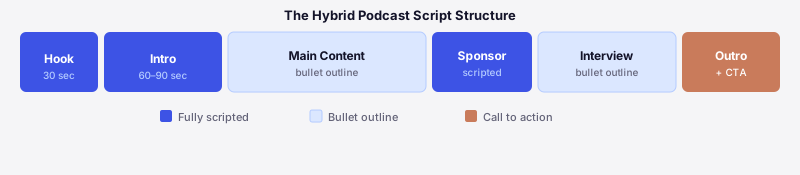
Hybrid. The intro, sponsor messages, transitions, and outro are fully scripted. The main content sections are bulleted. Most podcast scripts work this way. You get the polish of a scripted show without the stiffness.
If you are ghostwriting for a client, the hybrid format is almost always the right starting point. It keeps the scripted parts consistent across episodes while leaving space for the host's natural voice in the main segments.
The Six Elements of Every Podcast Script
Regardless of format, every episode script needs these six parts. Here is how they map to format and timing:
| Segment | Format | Typical duration |
|---|---|---|
| Hook | Fully scripted | 30 seconds |
| Intro | Fully scripted | 60–90 seconds |
| Main content / interview | Bullet outline | 5–10 min per segment |
| Sponsor message | Fully scripted | 60 seconds |
| Outro + CTA | Fully scripted | 90 seconds |
Before
“Hi everyone, welcome back to the show! Today I'm really excited to introduce our guest...”
After
Last Tuesday I spent four hours writing an article that should have taken 90 minutes. Not because the research was hard. Because I had no plan.
Hook (first 30 seconds). This is the most important part of any episode. Listeners decide whether to stay in the first half-minute. Open with a question, a striking fact, or a situation the listener recognizes. Do not open with "Hi, welcome back to the show." Write the hook last, once you know what the episode's best moment is.
Intro. After the hook, introduce the host, name the show, and tell listeners what they will get from this episode. Keep it under 90 seconds. "Today we're talking to X about Y, and by the end you'll know how to Z."
Main content sections. These are the core topics, questions, or segments. In a hybrid script, each section gets a header, three to five bullet points, and an approximate duration. Interview questions go here.
Transitions. Write a line or phrase that signals a topic change. It keeps the episode from feeling like a list of disconnected segments. "Before we get into that, I want to ask about..."
Sponsor message. If applicable, write this fully scripted. Keep it conversational. The host should sound like they are recommending something to a friend, not reading an ad.
Outro and CTA. Recap the main points, tease the next episode, and give one clear call to action. One thing only: a review, a follow, or a visit to a specific URL. Multiple CTAs dilute all of them.
A Podcast Script Template
Here is a template for a standard 20-minute hybrid episode. Copy it and fill it in before each recording session.
[HOOK: 30 seconds, fully scripted] Write the hook here. Start mid-scene or with a question.
[INTRO: 60-90 seconds, fully scripted] "Welcome to [show name]. I'm [name]. Today [guest name] joins me to talk about [topic]. By the end of this episode you'll [outcome for listener]."
[SEGMENT 1: 5 minutes, bullet outline]
- Main point 1
- Supporting detail or question
- Transition to next segment
[SEGMENT 2: 5 minutes, bullet outline]
- Main point 2
- Supporting detail or question
- Transition to segment 3
[SPONSOR: 60 seconds, fully scripted] Write the sponsor message word-for-word here.
[SEGMENT 3: MAIN INTERVIEW, 7 minutes, bullet outline]
- Core question
- Follow-up question
- Transition to outro
[OUTRO AND CTA: 90 seconds, fully scripted]
- Recap main takeaway in one sentence
- Thank the guest (if applicable)
- One call to action
- Tease next episode
The durations shift with each episode. The structure stays the same.
How to Write so It Sounds Natural on the Mic
The most common complaint about scripted podcasts is that they sound read. Here is how to avoid it.
Write for the ear, not the eye. Use contractions ("you'll" not "you will"). Keep sentences short. Start a sentence with "And" or "But" when it fits the rhythm. If you would not say it out loud to a friend, do not write it.
Run the read-aloud test. Before finalizing any scripted section, read it aloud. You will catch every awkward phrase instantly. Anything that makes you stumble needs a rewrite.
Build in pauses. Mark natural pause points with [pause] in the script. This gives the host time to breathe and gives the listener time to absorb.
If you are ghostwriting, capture the host's voice first. The most common ghostwriting mistake is writing in your own voice. Listen to existing episodes if they exist. Note the host's sentence length, vocabulary, humor, and how they handle transitions. Ask for a voice brief: what words do they use constantly? What do they never say? Then write in that register.
Research the audience before you write. A podcast script that connects with listeners uses the language listeners actually use. What topics do they bring up in comments and community forums? What questions do they ask repeatedly? How do they describe the problem this podcast solves? If you are ghostwriting for a client in a niche you are not familiar with, PhraseMine helps you map out how their audience actually talks: the exact phrases, the recurring concerns, the language that signals trust. It is the same research process that makes any piece of copy land, applied before you script a single episode.
Research the audience before you write the first line
PhraseMine searches Reddit and surfaces the conversations your client's audience is already having. Paste a brief, get back the language that makes every episode feel written for that specific listener.
Try PhraseMine freeA Filled Example: 20-Minute Solo Episode
Here is the template filled in for a solo episode about productivity for freelance writers.
[HOOK] "Last Tuesday I spent four hours writing an article that should have taken 90 minutes. Not because the research was hard. Because I had no plan for how the piece would end, and I kept rewriting the opening instead of moving forward."
[INTRO] "Welcome to The Freelance Brief. I'm Nnabuike. Today I'm sharing the one-page planning method I now use before every long-form piece. It sounds simple, and it is. But it cut my average writing session from four hours to 90 minutes, and the quality went up, not down."
[SEGMENT 1: Why long writing sessions fail]
- The planning fallacy: we think we know what we are writing until we start
- The blank page trap: rewriting the intro instead of moving forward
- Transition: "So here is what I changed."
[SEGMENT 2: The one-page method]
- Write the ending first, in one sentence
- List the three things the reader needs to believe before they accept that ending
- Map each section to one of those three beliefs
- Transition: "Now let's talk about today's sponsor."
[SPONSOR] "Today's episode is supported by Notion. I've used Notion for three years to manage every client project and research brief I take on. If your file system is currently a series of folders named 'final' and 'final-FINAL,' Notion will change that. Try it free at the link in the show notes."
[SEGMENT 3: Putting it into practice]
- The method works for both short and long content
- What to do when the ending is unclear before you start
- How to know when you have enough structure to begin writing
[OUTRO AND CTA] "The one-page planning method: write the ending first, map the three beliefs, connect each section to one of them. That's it. If this helped, leave a review on Apple Podcasts. It takes two minutes and helps new listeners find the show. Next week: client briefs that give you nothing to work with. See you then."
Notice how the hook uses a specific situation, not a generic welcome. The sponsor sounds like a recommendation, not an ad. The outro gives one CTA only.
Three Script Mistakes That Slow Down Recording
Writing too much. A word-for-word script for a 20-minute episode is roughly 3,000 words. That is a lot to write and a lot to read naturally. If you are scripting a conversational show, switch to bullet points and trust the host to fill in the words.
Skipping transitions. Without transitions, episodes feel like a list. Write even a single connecting sentence between each segment. It sounds like nothing on the page and fixes everything on the mic.
Over-scripting the interview questions. A scripted question is fine. But if the guest gives an unexpected answer, a host locked into a fully scripted follow-up will miss the best part of the conversation. Write questions as starting points, not scripts.
Your First Script Does Not Have to Be Perfect
Podcast scripting improves with each episode. The first one will feel stiff. The third will feel natural. Pick the hybrid format, write the hook last, and run the read-aloud test on every scripted section. That is enough to make the first recording session run smoothly.
If you are ghostwriting for a client, add one step before any of that: research how their audience actually talks. PhraseMine handles that research in minutes. The writing is yours. The audience intelligence has to come first.