
Two sales page examples. Same product. Same price. Same ad traffic. One converts at 4%. The other sits at 0.6%.
The difference isn't the design. It isn't the color of the button or the length of the page. It's the copy, and more specifically, whether the copy uses the exact words the buyer already has in their head.
That's what this guide is about. Not a gallery of pretty pages. Not a checklist of elements. A look at what copywriters actually had to know before they could write the sales pages that convert, and the specific data on why those choices worked.
What Separates a High-Converting Sales Page From a Dead One
Landing pages, as a category, convert around 6.6% of visitors into customers on average. That number sounds small until you realize the typical product page or homepage converts at 1-2%. The focused, single-goal format of a sales page is the reason for the gap. But averages hide the real story.
The pages that pull conversion rates above 4% share one trait: the copy sounds like the buyer wrote it.
The pages stuck below 1% share a different trait: they talk about features instead of transformation. Features are ingredients. Transformation is the meal. Buyers don't purchase software because it has 47 features. They purchase it because they want to stop spending 15 hours a week on manual data entry. Those are two very different things to put in a headline.
Clarity beats cleverness every time. A buyer who can't immediately understand what changes for them after buying will leave. You have about five seconds before that decision is made.
The Elements Every Strong Sales Page Has
Before the examples, here's what the research shows every high-converting page shares:
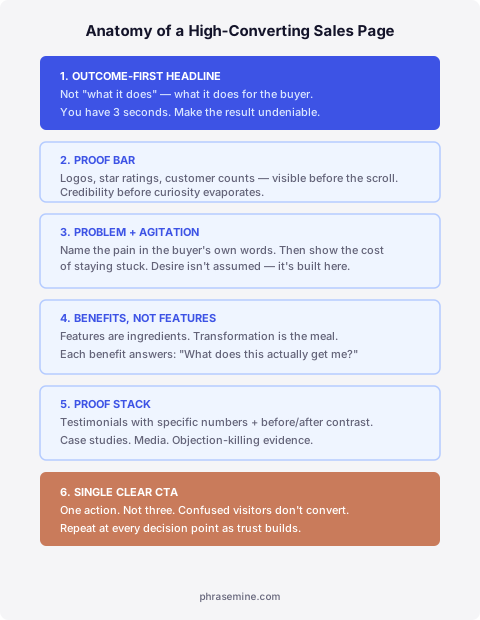
- An outcome-first headline. Not what the product does. What it does for the buyer. Specific, not vague. "Save 10 hours a week" beats "maximize productivity."
- A proof stack. Testimonials with specific numbers and a before/after contrast. Not "Great product! Highly recommend." Something like: "We were spending $8K a month on ads getting 200 leads. Now we get 600 leads for $2K. ROI went from break-even to 5x in three months." That's evidence. The other is noise.
- Objection handling. Every visitor has doubts. An unaddressed objection is an unconverted visitor. The page needs to say "this will work for you because..." and "if it doesn't, here's the guarantee."
- One primary CTA. Not three. Not "download," "contact us," and "buy now" all at once. Confused visitors don't convert. One clear next step, repeated at multiple scroll points as trust builds.
Three Sales Page Examples (And What the Copywriter Got Right)
| Example | Change made | Result |
|---|---|---|
| Business coaching page (Jenny Roth / Lindsay) | Rewrote page to speak to the specific buyer situation instead of generic entrepreneurs | 3x conversion rate |
| B2B SaaS landing page | Rewrote headline from product-focused to outcome-focused, added structured proof section | +157% conversions (2.1% to 5.4%) |
| Supplement VSL page | Shifted headline from ingredients to outcome, restructured proof with clinical refs + before/after | +161% lift, $38,000/mo additional revenue |
These aren't hypothetical pages. They're documented conversions with real numbers. And in each case, the copy that drove those numbers traces back to something the writer discovered through research, not something they invented at the keyboard.
Example 1: The business coaching sales page that 3x'd conversions
Copywriter Jenny Roth was hired to rewrite the sales page for a business coach named Lindsay. Lindsay ran a coaching business while working a full-time job and homeschooling her kids. She'd had a sales page. It wasn't converting.
Roth's rewrite 3x'd the conversion rate.
The lever wasn't a new framework or a cleverer headline formula. It was specificity. Lindsay's clients weren't generic entrepreneurs. They were people trying to build something while already stretched thin. The old page spoke to "entrepreneurs who want to grow." The new page spoke to people in Lindsay's exact situation.
Every word on a sales page is a filter. The more precisely you name who you're writing for and what they're going through, the more people in that situation feel like the page is talking directly to them. And people who feel seen buy.
What the copywriter had to discover first: what Lindsay's clients were actually dealing with day to day, in their own words. Not the polished version. The real version. The research happened before a word of the page was written.
+157%
Conversion lift from rewriting one headline and adding structured proof. No redesign, no new traffic. Just different words — aimed at the buyer's actual outcome instead of the product's features.
Example 2: The SaaS landing page rewrite that added 157% more conversions
A B2B SaaS company had a landing page converting at 2.1%. Nothing catastrophically wrong. Just not working hard enough. The page described what the software did. Features, capabilities, technical specs.
The copywriter rewrote the headline and added a structured proof section. The conversion rate moved to 5.4%. A 157% improvement, driven entirely by copy. No redesign. No new traffic source. Just different words.
The old headline: product-focused. Here's what we built.
The new headline: outcome-focused. Here's what you get.
That shift requires knowing what the buyer actually wants. Not what the product team thinks the buyer wants. What buyers tell each other when they're describing their problem in a forum thread, a support ticket, or a one-star review of a competitor.
The feature the product has isn't the thing. What the buyer can stop doing, stop worrying about, or start achieving because of that feature. That's the thing.
$38,000/mo
Additional monthly revenue from rewriting a supplement headline from ingredients to outcome. Same product, same traffic, same price — different words.
Example 3: The supplement VSL page that added $38,000 a month
A supplement brand had a sales page converting at 1.8%. The industry average for this category was higher. The copywriter diagnosed the problem quickly: the headline was about the product. It led with what the supplement contained.
After a headline rewrite that shifted from ingredients to outcome, and a restructured proof section that added clinical references and before/after testimonials with specificity, the conversion rate moved to 4.7%. A 161% lift. On the same traffic, that added $38,000 in monthly revenue.
The mechanism that drove the headline change: the buyer already knew what they'd tried and why it hadn't worked. They didn't need to be sold on the idea of a supplement. They needed to believe this one worked differently and why.
Finding that "why" is the research. The copywriter had to understand what buyers had already tried, what had disappointed them, and what belief they needed to form about the mechanism before they'd trust enough to buy. That information doesn't live in the product brief. It lives in what buyers actually say about their situation.
Find the exact words your buyers use before you write a word
PhraseMine searches Reddit for real customer conversations and organizes them by awareness stage, so you know what your buyer is thinking before you start the page.
Try PhraseMine freeHow to Research a Sales Page Before You Write It
Every example above worked for the same reason: the copy matched what the buyer was already thinking. Not what the product team hoped they were thinking. What they were actually thinking, in their own words.
That language doesn't come from brainstorming. It comes from listening.
Buyers describe their problems in very specific ways. "I've tried everything and nothing sticks." "I just need something that doesn't require a full team to manage." "Every tool I've used has the same problem." These phrases are gold. Drop one of them verbatim into a headline or a problem section and suddenly the page feels less like an ad and more like someone understands.
The research job before writing a sales page is to collect that language. Reddit threads, competitor reviews, customer interviews, support emails. Anywhere people talk about the problem honestly. If you want a structured approach to finding real customer language on Reddit, finding real customer language on Reddit covers the process start to finish.
For the broader method of building a research foundation before any project, voice of customer research for copywriters is a good starting point.
PhraseMine runs this research process automatically. You paste a brief, and it searches Reddit for real conversations about the problem, then organizes what people say by awareness stage. You can see how buyers talk about the problem before they know a solution exists, all the way through to how they talk when they're comparing options. That's the input a sales page needs before the writing starts.
Four Questions to Answer Before Writing Any Sales Page
Most weak sales pages are written by people who jumped to the keyboard too fast. Before you write a word, answer these four questions from actual research, not assumptions:
- What does the buyer want to change? Not what the product does. What situation the buyer is trying to escape.
- What have they already tried? This tells you what objections to address and what claims you can't make without proof.
- What do they worry will go wrong? The fears and doubts that show up in forum threads and reviews. Your guarantee and proof stack live here.
- What would make them feel certain enough to buy? This is the belief they need to form. It's also your headline.
These questions are the research, not the writing. Once you have the answers, writing sales copy that sounds like your customer becomes much more concrete.
What Every Example Has in Common
The supplement page, the SaaS page, the coaching page. Three completely different markets. But in each case, the before copy talked about the product. The after copy talked about the buyer.
That shift is only possible when the copywriter did the research first. You can't write "in the buyer's words" if you haven't spent time listening to how buyers actually talk.
The pages that convert aren't written from product briefs. They're written from research. And the research is where the work actually happens. PhraseMine makes that research part faster. Paste a brief, get back organized Reddit conversations in minutes.