
A client emails you. They say they need a landing page. You ask a few questions. They describe a page that walks visitors through the offer, handles objections, and ends with a buy button.
That's not a landing page. That's a sales page.
This mix-up happens all the time. People in marketing use the terms interchangeably, so clients often don't know what they're actually asking for. As the copywriter, sorting that out is your job before you write a single word.
Here's the full breakdown on landing page vs sales page: what each one does, how to write them differently, and how to figure out which one your client actually needs.
What a Landing Page Actually Does
A landing page has one job: get the visitor to give you their email address.
Not to sell anything. Not to explain the whole business. Just: here's something valuable, give me your email, and I'll send it to you.
The offer could be a free guide, a webinar registration, a free trial, or a discount code. Whatever it is, the visitor trades their contact details for something they want. That makes it a low-commitment ask, and low-commitment asks convert at high rates.
20–50%
Conversion rate for well-written landing pages on cold traffic. The lower ask — an email address, not money — is what makes that rate possible.
Landing pages convert at 20–50% on cold traffic when written well. Compare that to a sales page, where 1–4% on cold traffic is a strong result. The lower the ask, the higher the conversion rate.
What goes into the headline
The headline has one job too: tell visitors what they get in terms of the outcome, not the format.
"Download Our Free Ebook" tells them what they're getting. "The 7 Questions That Show You Exactly What Your Audience Is Afraid Of" tells them what they're gaining. Nobody opts in for a PDF. They opt in for the result the PDF promises.
Finding that sharp insight (the one outcome your audience wants and the one fear that holds them back) is where the research work happens. PhraseMine surfaces what people in your target market are already saying about their problems, so you can build a headline that reflects their language back at them.
How much copy is enough
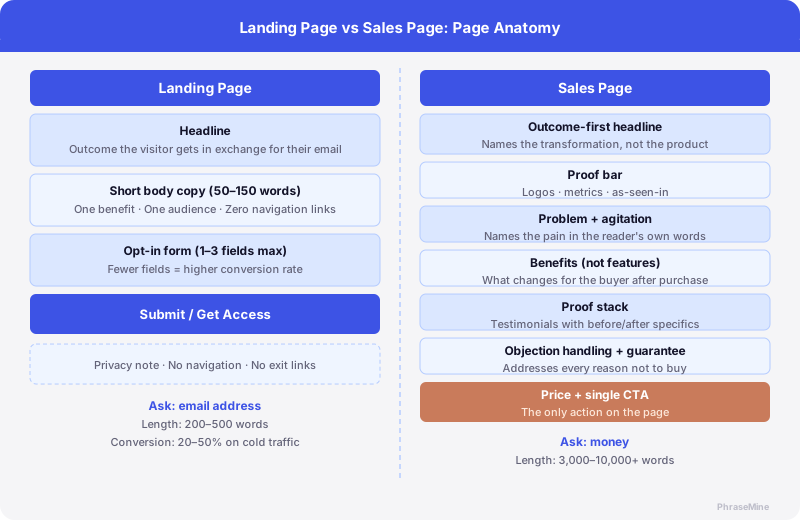
Short. 200–500 words is the range. Every sentence either moves the visitor toward the form or it doesn't belong on the page.
No navigation links. No footer menu. No links to other blog posts. Every extra link is an exit point. Strip them all.
One number worth knowing: three-field forms convert 25% better than nine-field forms. Unbounce's 2026 Conversion Benchmark Report found that three-field forms convert at 10.1%, while nine-field forms drop to 3.6%. Ask for an email address. Add a first name only if you have a real reason to. Stop there.
What a Sales Page Actually Does
A sales page has a different job entirely: convince a visitor to spend money.
That's a much higher bar than asking for an email address. It requires a more complete persuasion effort.
A sales page walks the visitor through the full buying decision in a single session. It covers the problem and why previous solutions failed. It explains what makes this offer different and proves that it works. It lays out the price, the guarantee, and a clear reason to decide now. Skip any of those stages and you leave a gap that kills the sale.
The length follows from how much doubt the visitor carries. Cold traffic on a high-ticket offer might need 8,000–10,000 words. Warm traffic buying a $47 product might convert at 2,000. You write until the persuasion case is complete.
1–4%
Conversion rate for sales pages on cold traffic. The higher ask — money — earns a lower rate. But each conversion is worth far more than an email address.
Conversion benchmarks: 1–4% on cold traffic, 5–15% on warm traffic. A health coaching sales page went from 0.78% to 16% conversion after a full funnel rebuild that included better audience research, tighter proof, and sharper objection handling. (Rakos Media, 2025.) For more on what actually moves the needle, see real sales page case studies with results.
The research requirement for a sales page is also deeper. You need the full objection stack: every reason a visitor might talk themselves out of buying. That research is what makes writing sales copy that sounds like your customer possible in the first place.
Landing Page vs Sales Page: Side-by-Side
Here's the full comparison in one table:
| Landing Page | Sales Page | |
|---|---|---|
| Primary goal | Capture an email address | Close a sale |
| The ask | Free content for contact details | Money for a product or service |
| Typical length | 200–500 words | 3,000–10,000+ words |
| Copy approach | Clear benefit, single CTA | Full persuasion architecture |
| CTA type | Opt-in form | Buy button |
| Funnel position | Top of funnel | Middle or bottom of funnel |
| Traffic suitability | Cold traffic | Warm traffic |
| Conversion benchmark | 20–50% | 1–4% cold, 5–15% warm |
| Copywriting scope | 1–2 days | 5–15 days |
How to Diagnose Which One Your Client Needs
This is the part that doesn't appear in most marketing guides: how to figure out what a client actually needs when they hand you a brief.
Start with one question. What do you want the visitor to do immediately after landing on the page? Give you their email, or give you their money?
Email means landing page. Money means sales page.
A few more questions that sharpen the diagnosis:
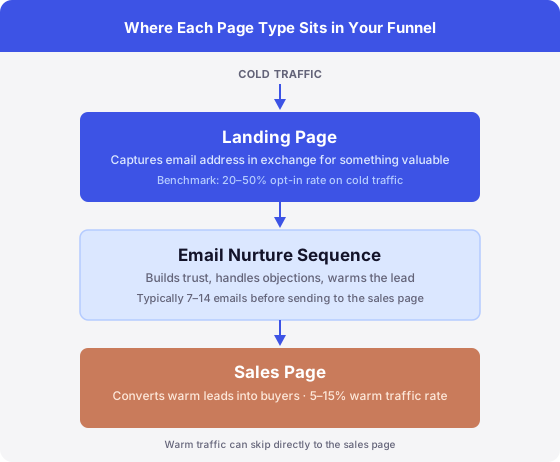
How warm is the traffic? Cold traffic (people from ads who've never heard of the brand) rarely converts on a sales page at first contact. A landing page captures them before they leave. An email sequence does the persuasion work. The sales page closes them once they're warm. Warm traffic, such as an existing email list or a retargeting audience, can go straight to a sales page.
What's the price point? The higher the price, the more persuasion the page needs. A $27 product can sometimes convert from a short pitch. A $2,000 coaching program almost never will.
What is the client actually describing? If they say "landing page" but describe a page with pricing, testimonials, and a buy button, that's a sales page. Catch that mismatch early. The right diagnosis before writing saves everyone revision rounds later.
The third scenario: build both.
The highest-converting funnels use both. The landing page captures the lead. The email sequence builds trust over days or weeks. The sales page closes the sale when the lead is warm enough.
A B2B SaaS company went from 2.1% to 5.4% conversion after they stopped sending cold paid traffic directly to their sales page and routed it through a landing page first. (Rob Palmer, 2026.) The copy didn't change. The sequence did.
Know what your audience expects before you write a word
PhraseMine finds the real language your audience uses when they're deciding whether to trust you. Paste a brief, get back organized Reddit conversations in minutes.
Try PhraseMine freeThe Research Each Format Requires
The two formats need different research going in.
For a landing page, you need one sharp insight: the specific outcome this audience wants and the one fear that stops them from opting in. Get the headline wrong on either of those, and the page won't convert, no matter how clean the design is.
For a sales page, you need the full picture. What they've already tried. Why it didn't work. The exact phrases they use when they describe the problem. Every objection they'll raise at each stage of the page. A sales page that skips any of that leaves doubt on the table.
This is where voice of customer research for copywriters makes a real difference. Finding the language your audience actually uses (not the polished version, but the raw version they use among themselves) is what separates copy that sounds like a marketer from copy that sounds like the reader's own thoughts.
PhraseMine does that research automatically. Paste in a brief describing the product or market you're writing for, and it surfaces real Reddit conversations organized by theme. You hear the actual language before you write a word. For a deeper look at sourcing that language, how to mine Reddit for copywriting research covers the process step by step.
When to Use Both Together
The landing page vs sales page question isn't always either/or.
Cold traffic rarely converts on a sales page at first contact. Most visitors aren't ready to buy the first time they encounter a brand. A landing page captures them before they leave. The email sequence does the persuasion work. The sales page closes them when they're ready.
That sequence (capture, nurture, convert) is where the best returns come from on paid traffic. It's also the structure most clients aren't thinking about when they email asking for "a landing page."
Your job is to help them see it.
The terminology gets confused all the time. Clients use "landing page" as a catch-all for anything that isn't the homepage. Your job is to sort that out before you start writing.
Landing page: captures a lead. Sales page: closes a sale. The research, the length, the copy structure: all of it follows from that one distinction.
Get the diagnosis right, and the writing gets a lot easier.