
Writing a podcast ad script is not the same job as writing a podcast script. You're not planning an episode. You're writing 30 to 90 seconds that have to feel like the host's genuine recommendation, not a commercial break.
And if you're the copywriter hired by a brand to produce that ad, the challenge doubles. You're writing for someone else's voice, on a show you may have never listened to, for an audience you need to understand quickly.
Host-read podcast ads have an 88% recall rate. That is the highest of any ad format tracked in industry benchmarks. When the copy is right, they work. This guide covers how to write one from scratch.
Pre-Roll, Mid-Roll, or Post-Roll: Pick the Format First
The placement determines the length, the structure, and how much story you can tell. Confirm this before you write anything.
| Format | Length | Listener state | What to write |
|---|---|---|---|
| Pre-roll | 15–30 seconds | Not yet invested in the episode | Short, direct. One benefit, one CTA. |
| Mid-roll | 60–90 seconds | Engaged for 20–30 minutes | Full structure: problem, solution, offer, CTA. |
| Post-roll | 15–30 seconds | Only the most committed listeners remain | Simple reminder. Assumes prior interest. |
Pre-roll. Plays before the episode begins. 15-30 seconds. The listener is not yet invested in the show. Keep it short and direct. One benefit, one CTA.
Mid-roll. Plays mid-episode, usually after the listener has been engaged for 20-30 minutes. 60-90 seconds. You have room to tell a short story: the problem, the solution, and the offer.
Post-roll. Plays after the episode ends. 15-30 seconds. Only the most committed listeners hear it. Keep it simple, like a reminder for someone who already wants to know more.
Most freelance brief work involves mid-roll host-read ads. That is where the longer copy structure applies, and where the rest of this guide focuses.
The Five Parts of a Podcast Ad Script
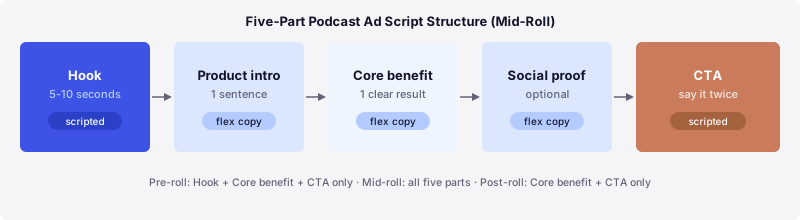
Every effective host-read mid-roll follows the same structure. The order matters.
Before
“Today's episode is brought to you by BetterSleep. BetterSleep has over 200 sleep sounds, meditations, and color noises to help you fall asleep faster...”
After
Last winter I went three months without sleeping through the night. I tried everything — white noise, melatonin, blackout curtains. What finally worked was one thing I hadn't thought to try.
Hook. The first 5-10 seconds. The listener decides whether to skip or stay. Do not open with the brand name. Open with a situation, a question, or a fact the listener recognizes. BetterHelp opens one of their best-performing ad reads with: "There are things to be gazelle intense about." No product name in the first ten words. The listener stays for the idea before they know what brand is behind the ad.
Product intro. One sentence. What the product is, not a feature list. "BetterHelp is therapy that fits your schedule, completely online."
Core benefit. One specific result the listener will get. Not three features. The one thing that matters most for this audience. AG1 has run the same core benefit across thousands of shows for years: it replaces your multivitamin. Everything else is secondary. Pick one and commit.
Social proof (optional). A brief trust signal. A guarantee, a customer count, or a risk-reversal: "try it for 30 days, return it for a full refund." Use this if the product is unfamiliar or the price requires justification.
CTA. One URL or promo code. Say it twice. "Visit brandname.com/show. That's brandname.com/show." Listeners are driving, exercising, or cooking. They cannot rewind instantly. The second mention is not redundant. It is necessary.
How to Write for a Host You Have Never Met
This is the part of the job most podcast ad guides skip. You are giving a script to someone who will deliver it in their own voice, on their own show, to their own audience. Write in your voice and the ad will sound wrong.
Before you write anything, do three things.
Listen to two or three episodes first. Note how the host opens topics. Are their sentences short or long? Do they use humor? Do they build to a point or get there fast? Write at that register.
Ask the client for a voice brief. What words does the host use constantly? What do they never say? What would make them uncomfortable to read aloud? You need those guardrails before you draft the script.
Write in flex copy, not fully scripted paragraphs. A flex copy format gives the host fully scripted lines for the hook and CTA, and bullet points for everything in between. The host fills in the middle with their own story and words, but the structure stays controlled. Here is how that looks in practice:
- Hook: [scripted] "Last winter I went three months without sleeping through the night."
- Product intro: [bullet] BetterSleep app: color noises, meditations, 200+ sleep sounds
- Core benefit: [bullet] Helps racing thoughts, not just white noise
- CTA: [scripted] "Download BetterSleep from the App Store. Link in the show notes."
The host delivers an ad that sounds like them. You deliver the structure that makes it work.
Research the Audience Before You Write
A generic ad underperforms because it sounds like it belongs on a different show. The best podcast ads work because the language, the problem framing, and the tone feel native to the specific show. Listeners notice immediately when something does not fit the show.
Before you write the hook, find out how this show's audience actually describes their problem in their own words. Not how the brand describes it. Not how you would describe it. What do they say in the comments, in the forums, in the subreddits adjacent to the show's topic?
PhraseMine runs that research for you. Paste a brief about the product and the show's audience, and you get back the actual phrases this audience uses before they know what the solution is. The hook you write from those phrases will land differently than one written from the client's brand deck.
The same voice of customer research that copywriters run before writing a sales page applies here. You're just running it faster, for a shorter format.
Find the exact words this show's audience uses
PhraseMine searches Reddit and returns the real phrases your target audience uses when they talk about their problem. Write a hook that sounds native to the show, not lifted from the brand deck.
Try PhraseMine freeHow to Format the Script File
A well-formatted script makes the host's recording session smooth. A poorly formatted one turns a short ad into a three-take problem.
Format your deliverable this way:
- One page, maximum. If the host has to scroll, the script is too long.
- Bullet points for the middle sections. Full, scripted sentences for the hook and CTA only.
- Bold the promo code and URL. These are the things the host cannot miss or mispronounce.
- Add guidance notes in brackets. "[Host can add personal story here, 10-15 seconds]" tells the host exactly where to improvise and where to stay on script.
- Include a timing target. "~60 seconds." The host needs to pace themselves before pressing record.
Hosts work with multiple sponsors across multiple shows. The easier you make your script to pick up and deliver, the more likely the ad sounds good on first take.
Three Mistakes That Hurt Podcast Ad Scripts
Too many talking points. Three to four is the maximum. A host covering eight product features sounds like they are reading a catalog. Decide on the one benefit that will move this audience and build everything around that.
Writing for the eye, not the ear. Complex sentences with multiple clauses are easy to read but awkward to say aloud. Long phrasing becomes stumbles on mic. Read every scripted line aloud before you send the script. Anything that makes you trip needs a rewrite.
Forgetting to say the CTA twice. Podcast listeners are often doing something else while they listen. They cannot rewind quickly. Saying the URL or promo code once means some conversions go to zero. Say it twice, every time, without exception.
Write the Structure, Trust the Host
The copy job in a podcast ad is specific: give the host the hook, the key messages, and the CTA, then get out of the way. The structure is yours. The voice is theirs. PhraseMine helps you nail the first step. Find the language your audience actually uses, so the hook you hand that host fits the show from the first word.