
A sales one pager does not close deals on its own. But it does something almost as valuable: it survives transit.
The rep sends it. The prospect forwards it to their manager. The manager shares it with procurement. At each stop, it has to work without anyone there to explain it. That constraint shapes every copy decision. Not design, not word count, not which sections to include.
This article covers what a sales one pager is, three types worth knowing, real examples of what works, and a section-by-section guide to writing one your client's sales team will actually send.
What Is a Sales One Pager?
A sales one pager is a short, shareable document that explains what a company does, why it matters, and what the reader should do next. It is usually one to two pages long. In practice, it functions as a leave-behind after a meeting, an attachment in a cold email, or a tool for the internal champion to share with stakeholders who were not in the original conversation.
The key characteristic that separates a one-pager from a brochure is that a one-pager travels. You write it to work in the hands of someone who was never in the original conversation. It should make complete sense to someone who receives it as a forward with no context. If it requires the sender to add a paragraph of explanation, the one-pager has already failed.
Three Types of Sales One Pagers Worth Knowing
Not every one-pager serves the same job. The type you write depends on where the prospect is in the sales cycle and what the client needs to move the deal forward.
Product or solution overview. The most common type. Explains what the product does, who it's for, and what result it delivers. This one goes out early, often in cold outreach or right after a first call.
Case study one-pager. Proof over promise. One client, one problem, one measurable result. This one is most effective once the prospect has shown interest but needs evidence that the solution actually works.
Comparison one-pager. Positions the client against alternatives: either named competitors or the status quo ("doing nothing"). Useful later in the cycle when the prospect is actively evaluating options.
Each type follows the same structural logic, but the emphasis shifts. Choose based on the moment, not personal preference.
What Every Strong Sales One Pager Includes
Five sections. In this order. With nothing extra.
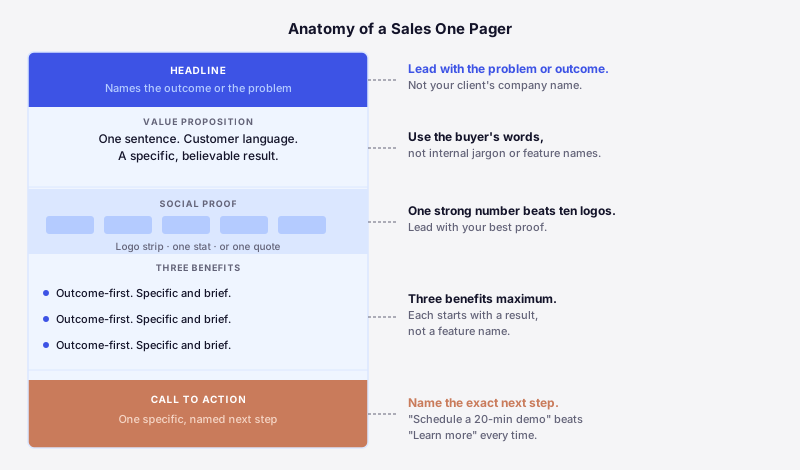
Headline. This is not the company name. It is not a tagline. It is the outcome the prospect wants or the problem they are already living with. "Stop losing deals in the follow-up" works. "Company Name: AI-Powered Sales Platform" does not.
Value proposition. One sentence that tells the reader what the company does, who it helps, and what specific result they can expect. Customer language, not company language.
Social proof. One strong proof point: a recognizable client logo, a specific metric, or a direct quote from a real customer. One number is worth ten logos. Lead with the most credible thing available.
Three benefits. Not a feature list. Each bullet starts with an outcome verb and connects to a result the prospect actually cares about. "Reduce onboarding time by 40%" works. "Includes advanced analytics dashboard" does not.
Call to action. One action. Named specifically. "Schedule a 20-minute demo" is better than "Learn more." The reader should know exactly what happens when they take the next step.
The Research You Do Before Writing
Before any word goes on the page, a copywriter needs to answer four questions that the client brief almost never covers.
Who is the second reader? The rep sends this to the prospect. But who does the prospect forward it to? That person (often a finance lead, a department head, or a technical evaluator) is the real decision-maker. Their objections and their language should shape the value proposition.
What is the one outcome this audience cares about most? Not what the client thinks they care about. Not what the product does best. What the buyer has described as their most urgent problem, in their own words. If the client has no customer research, PhraseMine surfaces real Reddit conversations about this problem category so you can find that language before writing a word.
What is the most credible proof available? One strong result from one real customer beats a generic claim every time. Push the client for a specific number: time saved, revenue added, deals closed.
What is the objection that always kills the deal? The one-pager should not address every objection. But it should quietly neutralize the most common one, often in the proof section or in a benefit bullet.
For a framework on running these two research conversations before you write anything, read the two research tracks every copywriter needs.
How to Write Each Section
Headline. Name the outcome or the pain. Keep it under twelve words. Test it against this question: if a stranger read only the headline, would they know what problem this solves? If not, rewrite.
Value proposition. Use this structure as a starting point: [who you help] + [specific outcome] + [what makes it different or believable]. Example: "We help enterprise sales teams close deals 30% faster without adding headcount." Adjust based on what research turns up. The exact words your client's customers use when describing the problem are your best source material. Read how to use customer language in copy for the method.
If you are writing for a client who has no customer research ready, PhraseMine can pull Reddit conversations about the prospect's category so you can find the actual language buyers use, not the language the client wishes they used.
Social proof. Ask the client for one specific result with a client name attached. If confidentiality is an issue, use a job title and industry: "A director of operations at a mid-market manufacturing company reduced onboarding time by 40%." A generic "improved customer satisfaction" is not proof. Push until you have something real.
Three benefits. Write outcome-first for each. Start with a verb that names the result: "Close," "Cut," "Reduce," "Win back," "Eliminate." Then name how. Then add the specific number or qualifier. Edit until each bullet could stand alone as a one-sentence pitch.
Call to action. Make it concrete. Name what happens next. "Schedule a 20-minute demo" is better than "Get in touch." "Download the full case study" is better than "Learn more." If the client wants two CTAs, choose one. A one-pager that asks two things gets neither.
Find the language your client's buyers actually use
PhraseMine analyzes Reddit conversations around any topic and organizes them by theme. Before your next one-pager, get the real words your client's buyers use.
Try PhraseMine freeSales One Pager Examples That Work
These patterns come from real one-pagers reviewed across B2B software companies. Names and details have been changed for anonymity.
The problem-first opener (Pendo-style). Headline names one specific pain: "Stop shipping features your users don't want." Body explains the three-step workflow. Proof is a customer logo and one adoption metric. CTA is specific. The entire document focuses on a single problem. Nothing else.
The proof-forward layout (Outreach-style). Bold headline states the outcome: "More pipeline. Less busywork." Quantified outcomes appear early: "Teams using this platform run 3x more outreach with the same headcount." Customer logos reinforce credibility. Benefits are written in plain language. Skim time is under ten seconds. Everything earns its space.
The persona-specific pitch. Same product, same structure, different emphasis based on who is reading it. The version for the IT buyer leads with security and compliance proof. The version for the operations lead starts with time savings. Neither version tries to appeal to everyone. Each one speaks to the person it was built for.
What these examples share: none of them start with the product. They all start with the reader.
One Pager vs. Sales Page: Which Format Does Your Client Need?
Clients often ask for a one-pager when they mean a sales page, and vice versa. The distinction matters because the two formats serve different moments and require different copy approaches.
A sales one pager is a conversation tool. It is designed to start a conversation, not end one. It goes out early, it gets forwarded, and its job is to spark enough interest to get a meeting.
A sales page is a conversion tool. It goes to someone who is already interested and close to making a decision. It works alone, without a rep to follow up, and its job is to get an order or a sign-up.
If your client has a product that sells through a sales team with multiple stakeholders, they need a one-pager. If they sell online without a salesperson involved, they need a sales page. If they sell both ways, they need both. Read landing page vs sales page for a full breakdown of when each format fits.
For real examples of sales pages that convert, with specific numbers and the research process behind each one, read sales page examples that convert.
The Test Before You Send It
The cold-reader test: hand the one-pager to someone with no context. Ask them to describe what the company does, who they help, and what the reader should do next. If they can't answer all three, the draft isn't ready. The failure is almost always in the headline or value proposition.
When the draft is done, run this test: give the one-pager to someone with no context. Someone who has never heard of the client. Ask them to read it and then describe what the company does, who they help, and what the reader should do next.
If they can answer all three, the one-pager is ready. If they cannot, it is not. The problem is almost always in the headline or the value proposition.
A one-pager that works without you in the room is a one-pager that travels.